
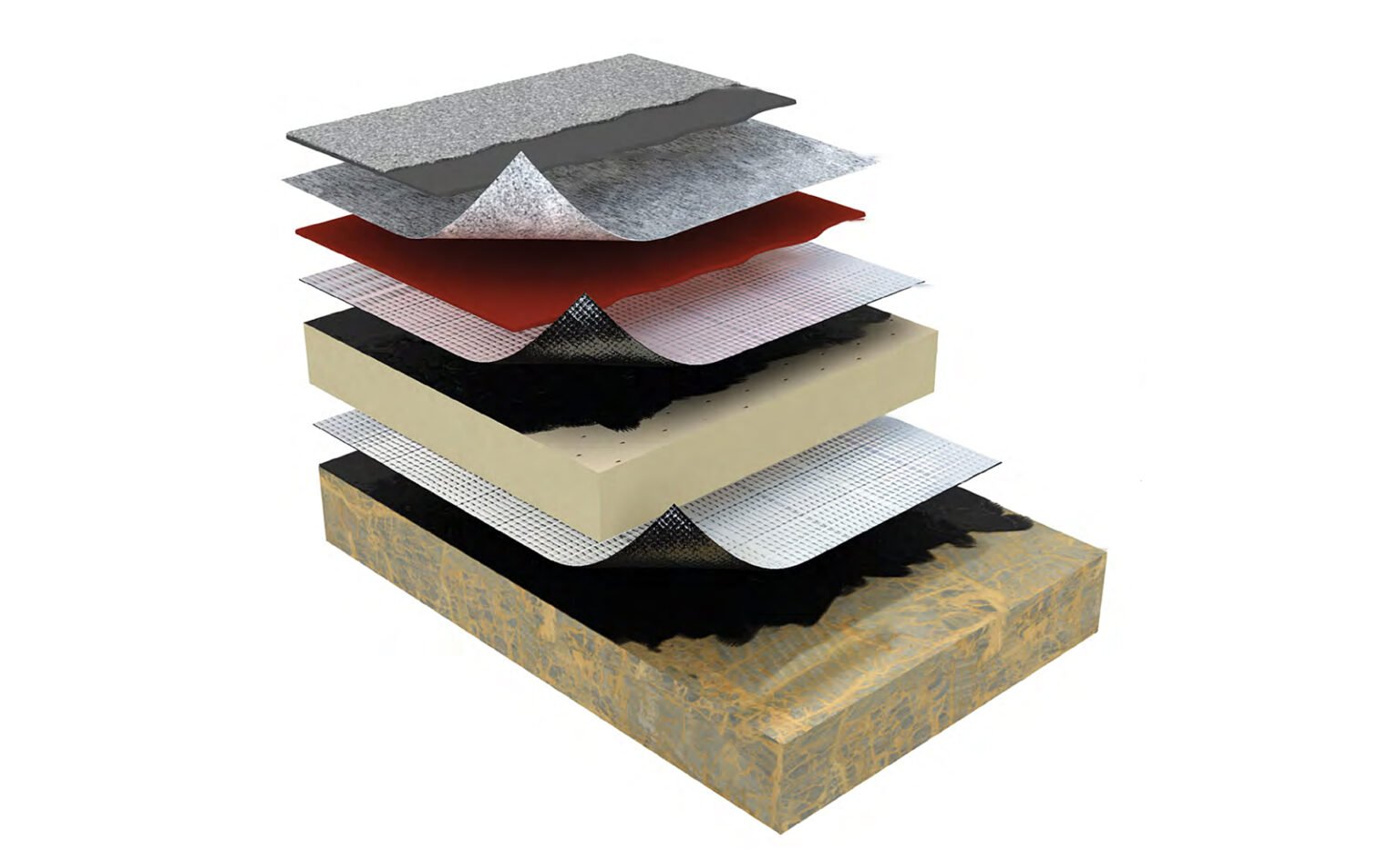
Stand on the roof of a large commercial building and, at first, there may seem to be very little to understand. The surface stretches outward in broad, quiet planes, interrupted by drains, vents, mechanical equipment, and the occasional parapet. Yet beneath that apparent simplicity lies an assembly whose success depends on decisions most people will never see. Among the oldest expressions of that principle are Built-Up Roof Systems, where protection is created not through a single decisive layer, but through repetition, reinforcement, and the careful accumulation of materials.
There is an appealing logic to this form of construction. One layer supports another. Bitumen works with reinforcing plies; those plies become part of a larger waterproofing assembly; the surface above them protects what has been built below. *The finished roof is not simply installed. In a very literal sense, it is built.*
That distinction explains much of the enduring character of built-up roofing. It also explains why BUR should not be judged only by tradition. A system can have a long history and still demand modern thinking about drainage, insulation, structural conditions, installation quality, maintenance, and the changing needs of the building beneath it.
“A roof becomes dependable not because one material is asked to do everything, but because every component is given a clear role in protecting the whole.”
Chapter One: The Logic of Layers
To understand built-up roofing, it helps to begin with the idea of redundancy. BUR typically develops its waterproofing through multiple reinforcing plies incorporated with bitumen and completed with an appropriate protective surface. Instead of placing nearly all emphasis on one primary sheet, the assembly creates protection through a sequence of integrated layers.
This is not redundancy for its own sake. Each component contributes something to the finished system, and the layers are intended to function collectively. The reinforcing materials provide structure within the waterproofing assembly. Bitumen integrates those materials into the roof system. Surfacing helps protect the underlying construction from exposure and ordinary rooftop demands.
The strength of the concept is cumulative.
That does not mean adding layers automatically creates a superior roof. Roofing performance cannot be reduced to counting plies any more than building quality can be measured by counting walls. Materials must be compatible, the substrate must be appropriate, drainage must function, and installation details must be executed correctly.
This is where built-up roofing begins to reveal its deeper character. Its value is not simply that it contains multiple layers; it is that those layers can create a substantial, integrated waterproofing assembly when designed for the property and installed with discipline.
Compare that philosophy with modern single-ply construction. TPO, PVC, and EPDM systems establish the primary waterproofing plane differently, using manufactured membrane sheets joined through system-specific seam technology. They can be excellent choices for commercial buildings. BUR simply reaches the same fundamental objective—keeping water outside the building—through another architectural logic.
Neither philosophy should be romanticized. *A multi-layer roof is not automatically better because it feels substantial, and a single-ply roof is not automatically better because it appears technologically simpler.* The correct system is the one whose physical characteristics, installation requirements, and maintenance expectations correspond to the building.
“Tradition becomes valuable only when we understand why it worked—and whether those same principles still serve the building in front of us.”
Chapter Two: What the Roof Must Endure
Every commercial roof lives a life far more demanding than its quiet appearance suggests. Sunlight reaches it before most occupants arrive in the morning. Temperatures rise and fall across its surface. Rain must find deliberate pathways toward drains and scuppers. Wind acts against edges and transitions. Maintenance technicians cross the roof to reach mechanical equipment, sometimes carrying tools and replacement components across the very surface responsible for protecting the occupied spaces below.
Built-up roofing responds to these demands through mass, layering, reinforcement, and protective surfacing, but the broad roof field is only part of the story. Some of the most consequential conditions occur where the roof changes direction or meets something else: at drains, curbs, penetrations, parapets, edges, and flashing transitions.
Water is patient. It does not need a dramatic opening; it needs only a pathway.
This is why drainage becomes one of the defining disciplines of low-slope roofing. A commercial roof may appear flat from the parking lot, but successful design depends on directing water toward appropriate drainage points. Blocked drains, poorly performing drainage areas, or changes in the roof surface can increase moisture exposure and place additional demands on vulnerable details.
The same principle applies to rooftop traffic. A roof designed to withstand decades of environmental exposure can still be damaged by careless servicing of HVAC or electrical equipment. Tools are dropped. Materials are dragged. New penetrations are sometimes introduced. The roofing system therefore exists not in isolation, but within the ongoing operational life of the building.
This broader perspective is essential when evaluating Multi-Layer Roofing Systems. Their durability should never be interpreted as invulnerability. The very qualities that make BUR substantial must be supported by competent detailing, appropriate structural consideration, controlled rooftop activity, and a clear maintenance strategy.
There are trade-offs as well. Built-up assemblies may involve different weight considerations, more installation stages, and project logistics that require careful planning compared with certain single-ply alternatives. Existing deck conditions, insulation, access, occupancy, and the configuration of rooftop equipment can all influence whether BUR is a practical choice.
A mature roofing decision acknowledges these limitations without diminishing the strengths of the system. Good design has never been about pretending trade-offs do not exist. It is about deciding which trade-offs a particular building can afford to make.
That is why the condition of an existing commercial roof should be understood before the replacement system is selected. A building with recurring leaks may have localized flashing problems, widespread membrane deterioration, wet insulation, drainage deficiencies, or some combination of these conditions. Simply choosing a new material without understanding what failed before risks carrying yesterday’s problems into tomorrow’s roof.
The most valuable inspection therefore does more than identify visible damage. It creates context. It asks how water moves across the roof, where service technicians travel, which areas have been repaired repeatedly, how rooftop equipment interacts with waterproofing details, and what accessible underlying conditions reveal about the assembly as a whole.
Only when the building has been understood should the roofing system be asked to answer it.
Chapter Three: The Long View
There is a temptation to think of a roofing project as something that ends when the crews leave. The final inspection is completed, equipment disappears from the property, and daily operations return to their familiar rhythm. Yet from the perspective of the roof, installation day is merely the beginning.
A commercial roof immediately enters a cycle of exposure and change. Seasons pass. Drainage pathways collect debris. Mechanical equipment requires servicing. Flashing and penetrations experience movement. Protective surfaces weather. Small conditions appear that may be insignificant when discovered early and considerably more complicated when ignored.
This is why preventive maintenance belongs within the original roofing strategy rather than being added years later. Regular inspections establish a record of how the system is aging. Drainage can be monitored, vulnerable transitions examined, rooftop activity documented, and developing damage addressed before interior water becomes the first indication that something has changed.
“The most economical roofing problem is often the one discovered while it is still small enough to be understood clearly.”
Eventually, every commercial roof reaches moments when larger decisions must be made. A localized defect may justify a compatible repair. Broader deterioration may lead to an evaluation of restoration possibilities. Widespread damage, moisture within the assembly, repeated failures, or unsuitable underlying conditions may shift the discussion toward replacement.
These choices should not be driven by age alone. *A calendar cannot inspect a roof.* Two systems installed in the same year may experience very different conditions depending on workmanship, climate exposure, drainage, rooftop traffic, maintenance history, and building operations. Physical evidence should therefore guide the decision.
For property owners, this is where lifecycle thinking becomes more useful than simply comparing initial project costs. The least expensive installation is not necessarily the least expensive roof to own, just as the most substantial assembly is not automatically the best investment. Maintenance requirements, repairability, installation logistics, disruption to operations, structural considerations, and future plans for the property all belong in the calculation.
Built-up roofing earns its place in that conversation because it offers something both practical and philosophical: protection through accumulation. Its multiple layers create a form of redundancy that has served commercial buildings across generations, yet its success still depends on thoroughly modern disciplines—careful evaluation, appropriate specification, skilled installation, drainage management, documentation, and preventive maintenance.
The lesson extends beyond BUR itself. A roof should never be chosen simply because it is familiar, newer, heavier, lighter, cheaper, or more technologically fashionable. It should be chosen because its characteristics make sense for the building beneath it.
And perhaps that is the most enduring idea within built-up roofing. The visible surface is only the final expression of decisions made below it. Layer follows layer. Detail supports detail. Each component contributes something that may never be noticed by the people working beneath the roof.
Years later, when rain moves quietly toward the drains and business continues uninterrupted below, no one is likely to think about reinforcing plies, bitumen, flashing transitions, or the careful sequence of construction that created the roof. They will simply experience the result.
In commercial roofing, that quiet absence of drama may be the clearest expression of success.